


When it comes to cleaning, Dyson has been a well-known brand for a long time. The company is known for its innovative design, powerful suction, and advanced cleaning capabilities. Two of their most popular models, the Dyson V6 and V7, have garnered a lot of attention from consumers.
In this article, we compare the two side by side on weight, suction, battery, design, noise, attachments and dust capacity, so you can decide which one fits your home. Both are also good picks for hard floors, which is why they appear in our guide to the best vacuum cleaners for vinyl floors.
Features and Specifications

Both the V6 and V7 are cordless stick vacuums that are light enough to carry from room to room. Here’s how their size and weight compare.
The V6 weighs about 4.5 to 5.1 pounds depending on the version, while the V7 weighs about 5.45 pounds, so the V6 is a little easier on your wrist. Both are about 9.8 inches wide, and the V7 is slightly longer at 49 inches versus 47.5 inches for the V6.
Lightweight: V6
Heavier: V7
Performance
On paper, the V6 and V7 have the same maximum suction of 100 air watts (AW), so on hard floors they clean almost the same. Both pick up fine dust, crumbs and pet hair from hard floors and rugs without trouble.
The difference shows up on carpets. The V7 versions come with a stronger motorized cleaner head that digs into low and high-pile carpet a little better. If you have a lot of carpet or a busy household, that cleaner head, plus the longer runtime, is the main reason to choose the V7.
V6 Best For: Hard Floors and Quick Cleanups
V7 Best For: Carpets and Bigger Homes
Battery Life and Charging Time
The portability and convenience of cordless vacuum cleaners is one of their benefits. However, battery life and charging time are important factors to consider. Both the Dyson V6 and V7 have good battery life, but there are some differences between the two models.
The V6 can clean for up to 20 minutes on a single charge, which is ideal for small to medium-sized households. The V7, on the other hand, runs for up to 30 minutes, even though its battery is slightly smaller (2,100 mAh vs 2,200 mAh), thanks to a more efficient motor. With the motorized cleaner head attached, expect about 16 minutes from the V6 and 20 minutes from the V7, and both drop to about 6 minutes in Max mode. When undertaking larger cleaning activities, the enhanced battery life might make a substantial difference.
V6 Runtime: 20 Minutes
V7 Runtime: 30 Minutes
The charging time should also be considered. Both models take about 3.5 hours to charge fully. It’s critical to plan ahead of time and make sure the vacuum cleaner is completely charged before each cleaning session.
V6 Full Charging Time: 3.5 hours
V7 Full Charging Time: 3.5 hours
Design and Usability
The design and usability of a vacuum cleaner can greatly impact the overall user experience. The Dyson V6 and V7 are both easy to use and made with ergonomics in mind. However, they have some different features.
Both models use Dyson’s classic trigger, so the vacuum only runs while you squeeze it. This saves battery, but it can tire your hand during longer cleaning sessions. The small difference is the power mode control: the V6 has a separate Max button, while the V7 uses a slide switch to change between normal and Max power.
V6 Power Control: Trigger plus a separate Max button
V7 Power Control: Trigger plus a slide switch for Max mode
The bigger design change is how the bin empties. On the V6, you press a red lever and a trap door opens at the bottom of the bin, but hair and dust often stay stuck inside, so you may need to pull them out by hand. The V7 uses a more hygienic system: when you pull the lever, a shroud slides down inside the bin and pushes the dirt out, so you rarely have to touch it.
V6 Bin Emptying: Trap door (may need manual cleaning)
V7 Bin Emptying: Hygienic push-out system
Cleaning Capabilities
Both the Dyson V6 and the V7 are very efficient and successful when it comes to cleaning. They are made to clean many different things, from carpets and rugs to hard floors and furniture.
The V6 comes with a direct-drive cleaner head that gives rugs a deep clean and gets rid of ground-in dirt. It also comes with a combination tool and a crevice tool for cleaning in tight areas and on different surfaces.
With a better cleaning head and a powered brush bar, the V7 takes cleaning to a whole new level. This makes it possible for the vacuum cleaner to get rid of pet hair, allergens, and fine dust from rugs and furniture. The V7 also comes with a combination tool, a crevice tool, and a small motorized tool, which gives you even more cleaning choices and ways to use it.
V6 Cleaner: Direct-drive Cleaner Head
V7 Cleaner: Cleaning Head and Motorized Brush Bar
Noise levels
Noise levels can be a concern for many consumers, especially those living in small apartments or with noise-sensitive individuals. When you compare the Dyson V6 and V7, they both make about the same amount of noise.
The V6 runs at about 82 decibels and the V7 at about 80 decibels, and independent tests have also found the V7 to be the quieter of the two. Both are loud, closer to a busy street than a normal conversation, but the difference is small in everyday use.
V6 Noise Level: 82 DB
V7 Noise Level: 80 DB
If noise is a big issue for you, you might want to look at models from Dyson’s V8 or V10 series, which run even more quietly.
Accessories and Attachments

Dyson offers a range of accessories and attachments to help their vacuum machines clean better. Both the V6 and V7 come equipped with a variety of essential cleaning equipment.
The V6 comes with a combination tool that doubles as a brush and a crevice tool, allowing for versatile cleaning on a variety of surfaces. It also includes a crevice tool for cleaning tight crevices and hard-to-reach locations.
The V7 goes a step further by including a small motorized tool. This tool is great for getting rid of pet hair from furniture and staircases. Whether you have pets or not, the little motorized tool can be useful for dealing with obstinate dirt and debris.
Additionally, Dyson sells a variety of compatible accessories and attachments that can be purchased separately, allowing you to tailor your cleaning experience to your unique needs.

Dyson Attachment Best Values
Dust Capacity and Filtration
When picking a vacuum cleaner, it’s important to think about how much dust it can hold and how well it filters out dust, especially if you have asthma or allergies. Both the Dyson V6 and V7 have effective ways to hold and filter dust.
The V6’s dustbin holds up to 0.4 litres, which is a good amount of dirt and debris before it needs to be emptied. This size is good for cleaning jobs that are small to medium in size. But you may need to empty the dustbin more often if you have a bigger home or often need to clean bigger areas.
The V7 has a bigger dustbin of about 0.54 litres (roughly a third more), so it can hold a bit more dirt and dust. This feature can be helpful if you have pets or live in a high-traffic place that needs to be cleaned more often.
Both models have Dyson’s advanced filtration system, which successfully catches allergens and fine dust particles and keeps them from getting back into the air. This is very important for people who have allergies or breathing problems.
V6 Bin Capacity: 0.4 litres
V7 Bin Capacity: 0.54 litres
Price and Availability
The V6 and V7 are older Dyson models, so stock changes often and you may find more renewed or refurbished listings than new ones. Before you buy, check the seller, the warranty length and the battery condition, since an older battery won’t reach the full 20 or 30 minutes of runtime. Use the Check Price buttons in the table below to see current availability.
Comparison Table Dyson V6 vs V7


Pros and cons of Dyson V6 and V7
To summarize the key advantages and disadvantages of the Dyson V6 and V7, let’s take a closer look at their pros and cons.
Dyson V6 Pros and Cons:
Dyson V7 Pros and Cons:
Should You Buy a Newer Dyson Instead?
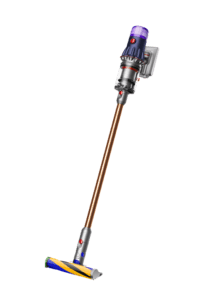
If your budget allows, look at Dyson’s newer cordless models before settling on a V6 or V7. The V8 is the closest step up, with about 115 AW of suction, up to 40 minutes of runtime and a 0.54 L bin. The V10 runs even longer, and the V12 Detect Slim adds a laser dust-detection head and an LCD screen that shows remaining battery time. The V6 and V7 still make sense if you want a lower price and mostly clean small spaces or hard floors.
Conclusion
After comparing the Dyson V6 and V7 on size, battery life, design, cleaning power, noise level, price, accessories and dust capacity, the V7 comes out ahead, but the gap is smaller than many people expect.
If you are on a tight budget and looking for a cheap choice, the Dyson V6 offers excellent cleaning capabilities and versatility. But if you are ready to spend a bit more and want longer battery life, a cleaner bin and better carpet performance, the Dyson V7 is the better option.
For most homes, the V7 is worth the small extra cost because of its 10 extra minutes of runtime and its easier, more hygienic bin. Choose the V6 only if price and weight matter most to you.
Dyson V6 vs V7 FAQs
What is the main difference between the Dyson V6 and V7?
The V7 runs longer (up to 30 minutes vs 20), has a slightly bigger 0.54 L bin with a more hygienic push-out emptying system, and comes with a stronger motorized cleaner head for carpets. Both have the same 100 AW maximum suction.
Is the Dyson V7 more powerful than the V6?
Not on paper. Both have about 100 AW of maximum suction. The V7 cleans carpets a little better because of its stronger motorized cleaner head.
No. Like the V6, the V7 uses a trigger that you hold while cleaning. The V7 adds a slide switch for Max mode, while the V6 has a separate Max button.
Which is lighter, the Dyson V6 or V7?
The V6, at about 4.5 to 5.1 pounds depending on the version, versus about 5.45 pounds for the V7.
How long do the V6 and V7 take to charge?
Both take about 3.5 hours to charge fully.
Should I buy the Dyson V6, V7 or V8?
If you can stretch your budget, the V8 gives you more suction (about 115 AW) and up to 40 minutes of runtime. Between the V6 and V7, the V7 is the better buy for most homes because of its longer runtime and easier bin.


